20 October 2022 (Paul Money: Astrophotography)

This week was another joint Zoom talk hosted by Beeslack Penicuik Camera Club. Paul Money, an astronomer and ‘Reviews’ editor of the BBC ‘Sky at Night’ magazine, connected from Lincolnshire to give us a guide to astrophotography. Paul has written a book on astrophotography called “Nightscenes: Guide to Simple Astrophotography” and mentioned that a new version of that book is about to be published.

Paul began by describing his early forays into astrophotography, using a Zenit film camera and high ISO slide film. Those were difficult days for astrophotography because the relatively low ISOs meant you needed long exposures, and you couldn’t see what you were getting until the film was developed. Paul was enthused by the latest developments in digital photography. His latest Canon camera can go up to 120000 ISO, and even modern mobile phones can now capture hand-held images of the night sky! Canon and Nikon cameras seem to be equally good at capturing good images of the night sky. We were given the following hints and tips for good astrophotography:

  • Turn off the noise reduction in your camera settings. Faint stars look like noise and will be removed.
  • Set your camera to manual exposure and manual focus. Most night shots are too dark for your camera’s autofocus to work properly. You can focus on a bright street light at least a mile away or use the “live view” option on your camera to adjust the focus to make the stars look as small as possible.
  • Most exposures will need a high ISO setting, but Paul recommends going no higher than ISO 1600 to get the best quality. Shots of the Moon or bright planets can be done at lower ISO settings.
  • Use a wide aperture, ideally a stop down from the widest setting of your lens. Paul tends to use f/5 but recommends stopping down to f/11 for scenes which include the full Moon or bright lights.
  • Use a decent tripod so you can take long exposures without camera shake. You can fit the tripod with a ball and socket bracket that allows you to point the camera upwards at any angle.
  • Also use a remote shutter release; preferably one that can make a timed exposure or take several exposures at regular intervals.
  • Don’t use a filter. You need to get as much light into your camera as possible through as few glass surfaces as possible.
  • Use a red light to help you see without spoiling your night vision. You can buy a special red torch or just cover an ordinary torch with a red wrapper.

Paul then gave us a quick introduction to the night sky. The stars rise in the east and set in the west and appear to rotate around the north celestial pole. If you point a camera north and take a long exposure you will see star trails revolving around the pole. The stars tend to move more slowly in the sky around this point, so you can get away with longer exposures before they start to trail. If you point your camera away from the pole the stars will move across the sky more quickly and you’ll need a shorter exposure. The exposure also depends on the kind of lens you are using, with telephoto lenses requiring the shortest exposure. Paul gave us the following guide to maximum exposure time before the stars start to trail:

  • Wide angle lens (18mm): Near the pole (60 seconds), Away from the pole (40 seconds)
  • Standard lens (50mm): Near the pole (30 seconds), Away from the pole (20 seconds)
  • Telephoto lens (135-300mm): Near the pole (20 seconds), Away from the pole (10 seconds)
  • Super telephoto (500mm): Near the pole (2 seconds), Away from the pole (1 second)

Paul took us on a quick-fire, enthusiastic and fascinating tour of various types of astrophotography, ranging from wide-angle shots of the constellations, star trails with foreground objects, telephoto views of the planets, a lunar eclipse, Earthshine on the Moon, noctilucent clouds and shots of the aurora borealis. Paul mentioned that, although most photographers like Adobe Photoshop, he prefers PaintShop Pro. He also recommended StarStax software for combining multiple images of the night sky.

If you would like more information here are some of our previous talks on astrophotography:

Ford Renton: Practical Astro-photography

Andy Bennetts: Astrophotography & Action Photography

Next week we have a Digital Photo Feedback session. This session replaces our old “Photo Advice Night”, which was based on prints. Please bring along up to 6 digital images (or email them to me) to get feedback and advice from other members. See you on Thursday.

Steven
29 September 2022 (Tesni Ward: Wildlife Photography)

This week, in a joint Zoom talk hosted by Beeslack Penicuik Camera Club, wildlife photographer Tesni Ward told us about her experiences in wildlife photography. Tesni is based in Sheffield. She first took up photography in her childhood as a way of encouraging her father to spend less time setting up photographs in a theme park and more time taking her on the rides! Her interest in wildlife photography began with a photographic holiday to Alaska, where she had the opportunity to see bears in their natural habitat. Her trip was spoiled when her main telephoto lens was damaged in flight. She saw other photographers taking superb clear shots while she ended up deleting hundreds of blurred attempts, and vowed never to be caught out by substandard equipment again. She learned from her experience with a damaged lens not to rely solely on long-distance telephoto shots. Tensi now takes shots at all focal lengths, with her wide angle shots taken after days of patiently getting to know her subjects and winning their trust. Tesni became a professional wildlife photographer when she was made redundant from her job, coincidentally just after buying new equipment and booking an African wildlife safari. A conversation with another photography on the trip convinced her to take the opportunity to change career and make a living from what she loves doing.

Tesni treated us to a breathtaking slide show of her photographs; ranging from her early shots of bears in Alaska, her photographs of big cats on her African safari, her shots of pelicans and coypu on a trip to Greece, and mountain hares, pelicans and seabirds closer to home. Each image came with a story of how Tensi had waited for hours for the light to improve, or how she had crawled over frozen mud to get to the correct spot. Other photographers sometimes laughed at her tenacity, but she eventually achieved the shot she wanted. A selection of these images can be seen in Tesni’s gallery (below).

During the tea break we had the opportunity to find a bird hiding amongst a photograph of jumbled rocks. Although several members could identify something strange in one part of the frame, it was Mike Clark who managed to home in on the exact spot. Well done Mike.

Tensi encouraged us all to try wildlife photography. You can check her web site to find out more about her workshops. She encouraged us not to be snobbish about the subjects. Shots of geese, ducks and pigeons are just as important as shots of pelicans and swans, as these creatures are just as important to their environment and might one day become rarer. All in all it was a very enjoyable and entertaining talk. Tensi showed us all just what can be achieved with a little determination and tenacity.

Next Thursday, 6th October 2022, Doug Bernt will be judging our Digital Projected Images competition. George Todd will also be collecting prints for the Colour Print competition. Please bring along your 3 mounted prints, if you haven’t already given them to George.

See you there,

Steven

22 September 2022 (George Robertson: The Snows of Kilimanjaro)

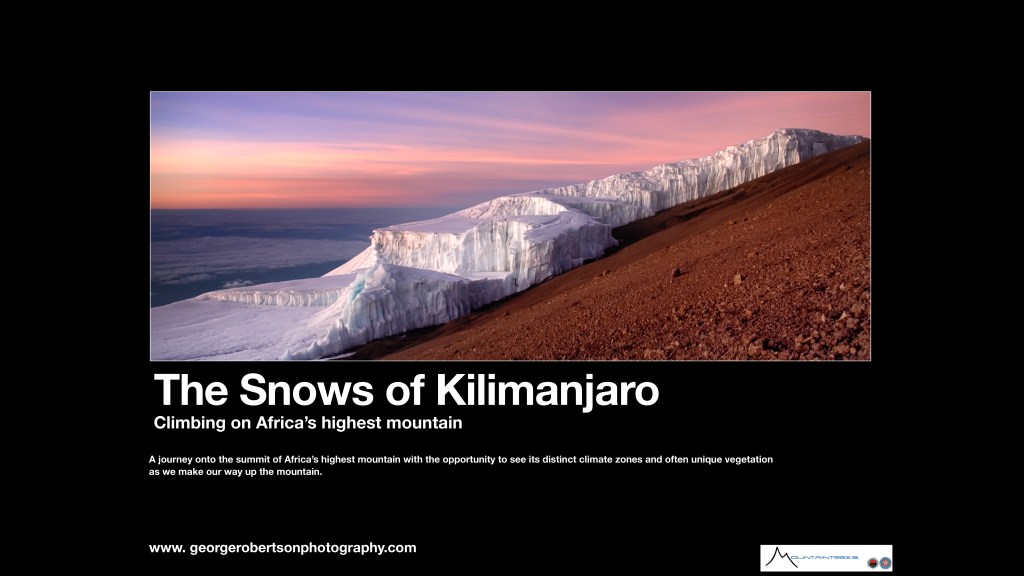
This week we had our first speaker of the season. George Robertson, who last year gave us a fantastic talk on his journey to K2 in “Into the Throne Room of the Mountain Gods”, returned to talk about “The Snows of Kilimanjaro, Climbing on Africa’s Highest Mountain”. George’s talk was shared with Beeslack Penicuik Camera club, with some Beeslack members opting to join us at the Fisherrow Centre and others opting to join by Zoom. George began his talk by repeating the introduction he gave us last year, explaining how his photography had begun from a need to record the experiences of the clients on his mountain adventure treks. You can find out more about George Robertson’s photography and mountain adventures on the following web sites:

https://georgerobertsonphotography.com/

https://www.mountaintreksphotos.co.uk/

http://www.mountaintreks.co.uk/

George first showed us a map of the routes he uses to take his clients to the summit of Kilimanjaro. His talk would show us highlights from two routes to the summit: one beginning at Machame and the other from Rongai. He explained that climbing Kilimanjaro is not a cheap option: it takes 6-7 days to complete the climb, and costs $120 per day to stay in the national park.

George’s trek began with civilisation and then moved up though the rainforest zone, with some beautiful photographs of the plants and wildlife visited on the way. The route then rose above the clouds and made way for moorland vegetation, and we started to see some spectacular views of the mountain ahead. George showed us pictures of the campsites, which had toilet blocks teetering on the edge of cliff! As George’s party climbed higher, the photographs became ever more spectacular; gazing across the clouds to the summit of Meru. We were taken into the Alpine Desert zone and shown pictures of a huge lava tower and the steep cliff face of the Barranco Wall, the hardest part of the climb. Eventually, we were treated to jaw-dropping shots of the icy glaciers on the mountain summit at sunrise, atmospheric shots of cloud formations, night shots of the campsite, and unique views of a rainbow surrounding a nearby peak and the Kilimanjaro’s shadow against the clouds. The final shot from the summit was of an American tourist sitting at the summit reading Ernest Hemingway’s “The Snows of Kilimanjaro”. George finished by showing us the route down the mountain back to the exit at Marangu. This time, more members were able to chat with George face to face after the talk. Another fascinating talk.

Next week we will be sharing a another speaker with Beeslack and will be treated to a wildlife photography talk from Tesni Ward. Tesni will be talking to us on Zoom, but her talk will be broadcast at the Fisherrow Centre (starting at 7:15 this Thursday). Zoom information will follow in due course.

See you there,

Steven

Our next meeting: George Robertson’s presentation on “The Snows of Kilimanjaro”

Our first speaker of the club season, George Robertson, will be visiting the club this week to give a talk entitled “The Snows of Kilimanjaro, Climbing on Africa’s Highest Mountain”.

The talk will be shared with Beeslack Penicuik Camera club. George will arrive in room G3 of the Fisherrow Centre at 7pm, and the talk itself will start at 7:15pm. You can find out more about George Robertson on the following web sites:

https://georgerobertsonphotography.com/

https://www.mountaintreksphotos.co.uk/

http://www.mountaintreks.co.uk/

George gave us a talk last year entitled “Into the Throne Room of the Mountain Gods” which was enthralling and entertaining. Click below to read more about it.

I look forward to seeing you this Thursday. We are in for a treat.

Steven