Astrophotography: How do you find out what’s up there?

I was asked if there are resources that will tell you what is coming up in the sky, so you can make plans for astrophotography. The answer is sufficiently useful that I thought I would post it to everyone. I think the very best web site for planning astrophotography is this one:

https://www.heavens-above.com/

Click on the link and you have a large number of options. I have programmed the above link to select “Musselburgh” as the default location. Click on “location” in the top right corner to see what the sky is doing where you live. The site is used by amateur astronomers, satellite and space enthusiasts, but the pages I think would be most useful for astrophotography are:

  • Interactive Sky Chart: This tells you what the sky looks like on any date. The zenith (looking straight up) is in the middle of the graph and the horizon is around the edge. Change the date to see how the sky will change in the future. You can, for example, see where the Milky Way crosses the horizon on each date. You can follow the planets and see if there are dates when they clump together and make a show at sunset or sunrise.
  • The Moon: This page lets you follow what happens to the Moon on future dates. You can check its phase and check when it might pass close to a planet and make a good show. For example, dial up 28th January 2020 and press “update” and you’ll see the crescent Moon passes close to Venus. If the sky is clear this would  be a good time to photograph the Moon as it sets.

Another very useful site is this one:

https://www.timeanddate.com/

The first thing you’ll need to do is click the “set home location” link under “Set time” and set your home location to Edinburgh, Scotland (it doesn’t know about Musselburgh). This site doesn’t have as many features as heavens-above, but it is is best site for predicting eclipses. Click here to bring up the eclipse planning page. The site is not as good at remembering your location, so make sure you type “Edinburgh, Scotland” in the “Place or country” box to get the correct information. You’ll find the next eclipse visible from here is a rather boring penumbral lunar eclipse on 5th June 2020. Keep tracking forwards and you’ll see there is a good solar eclipse on 10th June 2021. Put that date in your diary.

Finally, another site I find useful is this one:

https://spaceweather.com/

The site is dedicated to monitoring solar activity, so it is a good place to get sunspot and aurora predictions. The site doesn’t plan ahead but tells you what’s in the sky right now. It’s a good place to see alerts about aurorae or unusual clouds that could make interesting landscape images. Best of luck!

I hope all this will be useful to some members.


23 January 2020 ( Plant and Flower Photography)

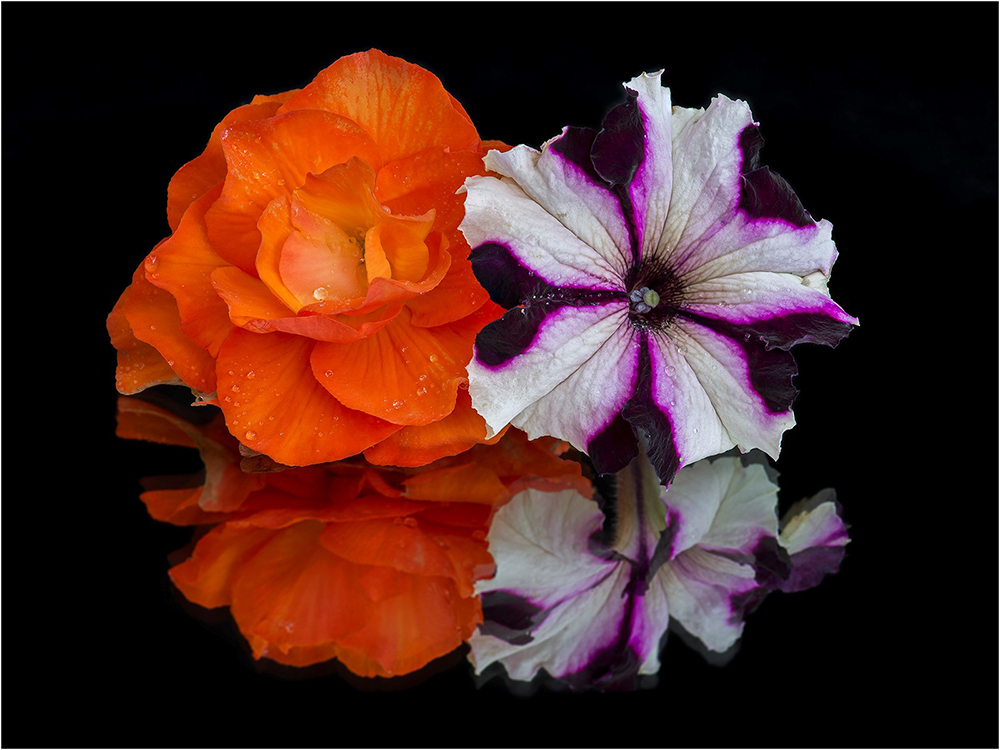
This week we had the pleasure of a visit from Liz Cole, a plant and garden photographer. Liz runs a Japanese Garden Photography course at the Royal Botanical Gardens in Edinburgh. Her images are regularly used by gardening magazines, books, newspapers and horticultural labels. It had been 9 years since Liz had previously given a presentation to Musselburgh Camera Club, so this one was long overdue.

Liz began by describing the equipment she uses for plant and flower photography. She uses Fuji X-Pro 2 mirrorless camera. The advantage of a mirrorless camera is that it is small and light, doesn’t attract attention, and yet still gives good quality photos. The camera has a very quiet shutter, which helps if you are photographing plants in a Japanese temple, and a good autofocus. Two types of lens can be used for flower photography. A macro lens lets you get up close and capture small details, but a medium telephoto lens will let you capture a larger plant or flower and blur out the background. A lens which gives a good out-of-focus bokeh gives the best results.  Liz recommends photographing plants and flowers by natural light. Using a flash can upset the colour balance (which is not good if you are aiming to use your image on a plant label).  A silver reflector can be used to brighten the shadows. It is possible to attach a circular reflector to the front of your lens to help with macro shots.  Adding a UV filter can help to improve the colours in sunlight and a polarizer filter can create a richer sky background.  Liz doesn’t use any other kinds of filter for plant photography.

Liz began by showing us the images of plants and flowers in their natural setting which she uses for horticultural magazines and plant labels. There were several beautiful images of Japanese gardens, common and exotic garden plants, trees and wild flowers captured in the Aberlady nature reserve. She used a lot of upward-pointing shots of trees which kept tourists and distractions out of the shot and captured the blossom against the sky or background plants or buildings. Liz then showed us a collection of studio portraits of plants and flowers which she had captured indoors or at flower shows. Unlike the outdoor shots, these images have a plain background. Liz uses a white, an 18% grey or a black background, as appropriate for each image. During her presentation, Liz gave us some hints, tips and great ideas for improving our photography:

  • Make sure you control the exposure so that flowers with white petals are not blown out in the highlights. Always underexpose a white flower.
  • If you don’t have a silver reflector handy, you can use the silver lid from a curry carton.
  • Check your plants carefully for ugly defects, pieces of dirt or lurking insects. Also (if you are allowed to) remove bits of rubbish from the surroundings. It is much better to get the shot right in camera than to try to fix it afterwards.
  • Don’t forget that seed heads and shoots can be just as beautiful as flowers.
  • If you want to ensure you have a plain background at a flower show, take along a print of an out-of-focus image of your own lawn. This kind of background can also be used for insect shots.
  • If you are using an artificial background make sure it is far enough away that your subject doesn’t cast a shadow on it.
  • If you are composing your images for a magazine cover, leave enough space for the wording at the top.

All in all this was a fascinating and enlightening talk.


16 January 2020 (Members Evening)

On 16th January, Mike Clark introduced club members to trail cameras. These are small, weather-proof cameras which can be left out in the wild for weeks and be programmed to record a video or take a still photograph whenever something triggers the camera’s motion sensor. Mike was surprised at how cheaply you can buy these cameras, and had bought himself a TOGUARD trail camera. Trail cameras are very good at capturing moments you could have spent hours trying and failing to capture with a conventional camera. The camera lies in wait and, if something interesting happens at (say) 4am while you are asleep, the camera will capture it. Every image is time-stamped. Mike’s camera could record images at night using an infra-red light. Mike recommended buying a camera with a good battery life and decent-sized memory card, because the longer you can leave the camera running unattended the better the results.

Mike showed us a collection of images his camera had captured during 2019, from a fox which visited his garden at night, a deer and several birds, to a family of badgers frolicking around their set. The motion sensor was even sensitive enough to pick up a spider walking in front of it! Mike had learned not to be tempted to leave food for the wildlife because you get a lot of similar shots of chewing animals. His best and most natural shots were made by placing the camera in a thoroughfare and waiting for the animals to pass by.

We finished the evening by showing images from the latest Dingwall competition CD.


09 January 2020 (Set Subject Competition – Travel)

We opened the second half of our 2019-2020 season with the first of our 3 set subject competitions. The competition opens with the subject of “Travel”.  Jim Tod had won last year’s “Seascapes” competition and earned the right to judge this year’s competition.  Jim began the evening by drawing our attention to the commonly-accepted definition of travel photography:

Photography that may involve the documentation of an area’s landscape, people, cultures, customs and history. The Photographic Society of America defines a travel photo as an image that expresses the feeling of a time and place, portrays a land, its people, or a culture in its natural state, and has no geographical limitations.

42 images had been entered in total from locations near and far, including Scotland, England, Czech Republic, Latvia, Estonia, Iceland, Vietnam, India, China, the Galápagos islands, South Africa and New Zealand! There were landscape images showing the beauty of these locations, portraits of people going about their business, shots of interesting things and photographs of various forms of transport. The best images were the ones which combined these aspects, showing people in the context of their culture or landscapes connected with iconic local landmarks. The transport images had more impact if they showed people using the transport and included a clue to the destination in the frame (for example an image of a ferryboat approaching a jetty had more impact than a shot of a boat isolated in the middle of a lake). Blown highlights were a common fault. Many shots had been taken in bright sunlight and the use of a polarizer filter and better control of the exposure would have helped those shots.  Jim explained how some of the shots could be improved by a better viewpoint or better camera angle. The adventures of Sven Martin Bullwinkle (a series of images showing a cuddly toy journeying through Scotland) raised some laughs with the audience!

The top-scoring images were

  • A Long Way from London (Malcolm Roberts) – 20 points
  • Lake Cruiser (Mike Clark) – 20 points
  • No Room For A Passenger (George Todd) – 19 points
  • River Crossing (George Todd) – 19 points
  • Morning Commute (Joe Fowler) – 18 points
  • Mainline Steam (Mike Clark) – 18 points
  • Line (Kevin Johnston) – 18 points
  • The Beagle At Dawn (Anne Yeomans) – 18 points

The deciding factor in this competition was consistency,  and the top places went to members who had consistently good scores across all three images. The highest scorers were:

  • 5th place (47 points)
    • Anne Yeomans
  • 4th = place (49 points)
    • Joe Fowler
    • Lorraine Roberts
    • Gordon Davidson
  • 3rd place (50 points)
    • Malcolm Roberts
  • 2nd place (51 points)
    • Mike Clark
  • 1st place (55 points)
    • George Todd

Thank you very much to Jim Tod for judging this competition over his Christmas holiday. Congratulations to George Todd, who wins the right to judge next year’s competition.

This is the first in a 3-part competition, with George, Mike and Malcolm now standing at the top of the league table. The next two parts will be the “Wildlife” competition (hand-in date 23rd January 2020) and the “Old Faces” competition (hand-in date 5th March 2020). If your images didn’t do well in this competition don’t despair.  The final result depends on the total score from your best 2 competitions, so there is still everything to play for.

MAMA Revue 2020 Dress Rehearsal

The club has received the following message from Jane Renton, Musselburgh Amateur Musical Association president.


Happy New Year! I hope you are well.
The dress rehearsal for our upcoming Revue is next Wednesday (15th) in the Brunton theatre and once again I was wondering if any of the members of Musselburgh Camera Club would like to come along and take some photographs. The rehearsal will probably start about 7pm – 7:30 ish and we have to be out of the theatre by 10pm. If anyone is interested in coming along could they maybe drop me an email at jane.renton@btinternet.com, just so I know how many people to expect and so I can let them know if there are any changes in timing.
Many thanks
Best wishes
Jane

Set Subject “Travel” Competition This Week

Happy New Year to members!

A reminder that our club evenings restart this week. On Thursday, 9th January 2020 at 7:30pm, Jim Tod will reveal the result of our first set subject competition on the theme of “Travel”.

This Thursday is also the hand-in date for prints submitted to the Human Portrait Print Competition. In this competition colour or black and white prints are accepted, as long as the main subject is a person or group of people. Please bring 3 mounted prints and send JPEG copies of your 3 images to George Todd at georgetodd1957@me.com.

Please ensure that competition prints are attached to mounts no larger that 40cm x 50cm in size, as larger mounts will not fit into the carrying folder. The club mount cutter will be available this Thursday if you need help cutting a mount to size.