10 October 2019 (A Journey to 80 Degrees North: The Land of the Polar Bear

On 10th October 2019, Christine Murdie gave us a fascinating, illustrated story of her journey to the arctic to carry out a survey. Christine is a qualified conservationist who works for the marine charity Orca, which is committed to studying and protecting whales, dolphins and porpoises.

Click here to see about some of Christine’s recent surveys for Orca.

Christine described a cruise to the Barents Sea via Norway, where she was tasked with counting and photographing wildlife (especially cetaceans). She showed us the images taken en-route: some of the wildlife she was surveying and some of the spectacular scenery which distracted her from the wildlife. On the way she visited Stravanger, Lysefjord, Bergen, Andalsnes, Alesund, Rorvik (where she spotted a lion’s mane jellyfish), Torghaten (with views of the seven sisters mountain range), the Lofoten Islands,  Trollfjord (place of trolls), Tromsø,  Honningsvåg, and then arrived at the northern cape of Norway. After that, the ship travelled on to Bear Island and Svalbard. Amongst shots of the breathtaking scenery, Christine showed us some rarely-seen images of whales with babies and blue whales breaching.

The story, though spectacular, was tinged with some sadness. There was far less snow up above the arctic circle than there used to be just a few decades ago, and she has watched the glaciers are retreating over the years. The idyllic Norwegian fishing towns contrasted strongly with the ugly and polluting Russian mining operations in the Barents Sea. The wildlife count was smaller than it used to be, and some species (including the polar bear featured in the title of the talk) were not seen at all during the most recent trip. All in all, a fascinating talk with a conservation message for us all to take away.

03 October 2019 (Digital Projected Images Competition)

This week we kicked off our club competition season with the Digital Projected Images competition. The competition was judged by Simon Wooton of Midlothian Camera Club. Click on the link below to see Simon’s gallery of landscape, sport and wildlife images.

Simon Wooton’s image gallery.

Simon had 72 images to judge and had gone to the trouble of providing a whole page of feedback on each image. We will print out Simon’s document so members can read the comments on their own images.There were several images of flowers, landscape and seascape images (some from as far away as New Zealand) , architectural shots from Edinburgh, sport and street photographs. Distractions in the background or around the edges of images were common comments, and some images were a little too dark or too bright. There were some beautiful sky images which didn’t quite work on their own. Two images stood out as discussion points because of their humour: “Beemer” by Edward Robertson and “What Does She Want?” by Carol Edmund. Both shots were funny and timed beautifully but had too many distractions to be successful competition images. Even so, thank you for entering them and cheering us up.

A mix-up with the score sheets meant we could only give a preliminary result on the night, but we can now announce the final results. The top scorers were (in reverse order):

  • 5th place (48 points)
    • Jennifer Davidson
    • Elaine Gilroy
    • John West
    • Howie Findlay
  • 4th place (50 points)
    • Steven Beard
    • Mike Clark
    • Anne Yeomans
  • 3rd place (52 points)
    • Joe Fowler
    • Malcolm Roberts
  • 2nd place (55 points)
    • George Todd
  • 1st place (57 points)
    • Jim Tod

The top images were:

  • Tarasay (Jim Tod) – 20 points
  • Growth Amongst Decay (Jim Tod) – 19 points
  • Two Ducks At The Waterhole (George Todd) – 19 points
  • Fabrication Welder (Joe Fowler) – 18 points
  • Move Over (Joe Fowler) – 18 points
  • Remarkable Rainbow (Malcolm Roberts) – 18 points
  • Church Of The Santissimo Redentore (Jim Tod) – 18 points
  • Circle Of Flowers (Steven Beard) – 18 points
  • Taking Jump Number Nine (George Todd) – 18 points
  • Brown Bear Confrontation (George Todd) – 18 points
  • Razorbill (Anne Yeomans) – 18 points

Well done to Jim Tod for winning the competition and achieving first and second place with two of his images.

Next week Christine Murdie will be giving us a fascinating-sounding presentation entitled “A Journey to 80 Degrees North: The Land of the Polar Bear”, and the week after that we will go through the competition images a second time, with more opportunity for feedback and questions.


19 September 2019 (Introduction To Photography)

This week I gave an introduction to photography presentation for club members. Whereas last year I gave a demonstration with my own camera, this year I encouraged members to bring their own cameras and try some exercise themselves. My slides were very similar to previous presentations, and you can download a full set of notes by clicking on the link below.

MCCIntroductionToPhotographyNotes

This time I included some exercises where members photographed sheets of white and black paper and observed how their camera behaved in auto exposure mode. I also set up two makeshift studios: one where a piece of sea coal could be photographed against a white background and another where some white sweet peas could be photographed against a black background. If you are new to photography, or are just starting with a new camera, here are some points to take away:

  1. Learn how to configure your camera so it displays a histogram. For some cameras this involves viewing an image and then pressing an “info” or “display” button to cycle through the various options. Your camera’s instruction manual will tell you how to do it. A histogram that is bunched up on the left hand side suggests your image is under-exposed and a histogram bunched up on the right hand side suggests your image is over-exposed.
  2. If you are new to photography, or are trying out a camera for the first time, start by using the “Auto” modes provided by the camera. When you use these modes you are telling the camera to decide what settings and exposure to use. It helps if you give the camera information on the kind of photography you are doing. There might be special auto modes labelled “landscape”, “portrait”, “sport”, “night scene”, etc… You will find some camera controls locked in these modes (for example the flash pops up when you don’t want it to), which can be frustrating when you want to take more control. The next mode to try is “P”: This is still a fully auto mode (the camera decides on both the aperture and shutter speed) but it lets you take full control over other settings, such as ISO (sensitivity) and flash mode. The most popular modes for creative photography are “A” (set the aperture and let the camera decide the shutter speed – useful for landscapes, portraits and still life) and “S” or “Tv” (set the shutter speed and let the camera decide the aperture – useful for sport and wildlife telephoto shots). But the most creative and flexible mode of all is “M” (manual). Here you take full control of all the camera settings. Manual mode is essential for getting good shots in very unusual situations where the camera meter no longer works properly (for example astrophotography).
  3. All the camera modes except “M” are automatic modes where the camera chooses the overall exposure. Since the camera doesn’t know what it is photographing, it can make mistakes. A white piece of paper and a black of paper are rendered almost the same shade of murky grey. Look for a button on your camera with a symbol similar to the one below. This is the “exposure compensation” button. You can use it to correct the mistakes made by your camera. For some cameras you can adjust the exposure compensation by holding down this button and turning one of the control dials. Other cameras might have a special dial labelled -3,-2,-1,0,+1,+2,+3 which you can turn to the required setting. Changing this setting to +1 when photographing the white paper adds 1 stop to the exposure, and the paper should look a much better shade of white. Changing the setting to -1 when photographing the black paper subtracts 1 stop from the exposure, and the paper should look a more satisfying shade of black. You can fine-tune the setting until the histogram on the back of the camera looks right (see point 1). Don’t forget to restore the setting back to 0.0 when you have finished.
  4. You can bend a sheet of white or black card into a curve and stick it with masking tape between a horizontal surface (table?) and vertical surface (wall or plastic box?) and make an “infinity curve” (or “infinity cove”). This creates a space where you can photograph objects against a plain background which looks like it never ends. These can be quite expensive when purchased as part of a studio, but a piece of card is a much cheaper alternative. The best way to use an infinity curve is with a diffuse light source which casts no shadows. If the natural light in your room doesn’t work, try pointing your flash straight upwards and ask someone to hold another white piece of paper above your camera so the light is reflected from it.
  5. When shooting against a white background, try a positive exposure compensation and when shooting against a black background try a negative exposure compensation (see point 3). You can also try using your camera’s “spot” exposure mode and place the spot on the object.

Joe finished the evening by giving a mounting masterclass with the club’s new mount cutter.

I hope my presentation helps you get the best use from your camera. Best of luck. 🙂


12 September 2019 (Recorded Lecture)

On our second club night of the 2019/2020 season we watched a CD of images accepted into last year’s Dingwall National Projected Image Competition. We watch these images to give us some inspiration and also see what kind of images are popular at the moment. In the “Landscape” section there were many photographs of reflections and aurorae, but images of a lone tree against a snowy background seemed to do particularly well in the competition this time. The “nature” category included a wide variety of images, ranging from a dangling slug to a group of lions.

Next week (Thursday, 19th September) I will be giving my “Introduction To Photography” presentation. Bring along a camera to join in some practical demonstrations.

Some club announcements:

  • Joe Fowler will be giving a photography and mounting class for new members and beginners. If you are interested please see Joe at the next club meeting.
  • Musselburgh Camera Club will be taking part in the Musselburgh Communities Day at the Brunton Hall from 11am-3pm on Saturday, 21st September 2019. We need some volunteers to help look after the display. If you can help please contact Steven Beard at StevenMBeard@aol.com.
  • Jim Tod is arranging two club outings in the near future.If you are interested in any of the four options below, contact Jim at jim@todfamily.me.uk or sign your name on the sheet hanging up on the noticeboard.  Ask Jim for detailed directions.
    • The first outing is a masterclass in seascapes and long exposure photography on Saturday, 21st September. There are two options: (1) Meeting at 06:30am at the old outdoor pool in North Berwick to photograph the sunrise; and (2) Meeting at 09:30am at Seacliff Beach (off the A198 near North Berwick).
    • The second outing is an autumn photoshoot in the Trossachs on Saturday 19th or Sunday 20th October (depending on Scotland’s rugby world cup fixtures).  Again there are two options: (1) Meeting at 7.30 am at boathouses south end Loch Ard to capture the early morning light; and (2) Meeting at 10:00am at Kinlochard Village Hall.

Some photographic opportunities coming up:

Welcome to the 2019-2020 Season

Welcome to the 2019-2020 season!

I would like to welcome everyone to another season with Musselburgh Camera Club. Thank you to all who came along to this week’s opening night, especially to the potential new members who I hope we can make feel at home. If you signed up with the club you will have been given a printed copy of the syllabus. You can also find a copy of the syllabus on the web site by clicking here.

New members will also have received a copy of the guide to club competitions. You can also download a digital copy of this document by clicking the link below.

MCCCompetitionInformation

The competitions start early this season, and entries for the Digital Projected Images (DPI) competition close next week, 25th September 2019!

We begin the new season with a refurbished laptop, thanks to Jim Tod.

Congratulations to Malcolm Roberts for winning the Sunday Times weekly “big shot” photography competition on 9th June with his shot of Antelope Canyon!

The club now has a mount cutter which members can use to improve the appearance of their mounted prints. Joe Fowler has offered to arrange a mounting masterclass for those interested in learning how to use it. Watch this space…

A reminder of some events coming up:

Please click the link below to see the club’s privacy policy, which explains how we use the contact information you provided when you signed up. It should be fairly straightforward, since we don’t pass on your information to third parties or use your details for any other reason than running club activities.

MCCDataPrivacyPolicy

I look forward to seeing you next week, when we will share an inspiring CD of high quality images from the Dingwall competition.


Visit by Musselburgh Camera Club members to Mölnlycke Fotoklubb, Gothenburg 26-29th April 2019

Helen and Martin Lunden from Gothenburg joined Musselburgh Camera Club while working in Edinburgh. A link and competitions, with an exchange of digital images, had been established by Musselburgh Camera Club with their home club, Mölnlycke Fotoklubb in Gothenburg, Sweden’s second largest city in the west of the country. The Swedish club invited a group of Musselburgh members to travel over for a visit and 8 members signed up to visit them for a weekend.

We were made extremely welcome by the Mölnlycke Fotoklubb members, in particular Helen and Martin went above and beyond the call of duty to show us the best of Sweden and entertain us.

The Friday evening was very warm and we walked through the cobbled old Haga district where we had a meal with a few Mölnlycke members and later strolled back to the hotel.

Saturday was Fika (a Swedish tradition of mid-morning coffee and a bun) followed by a day being driven around the west coast islands by the club members, followed by a meal in a cosy restaurant. Sadly it rained for most of the day, but didn’t stop us enjoying it. The scenery is stunning; lots of small islands with little coloured houses, beautiful rock forms and wild flowers.

Sunday morning was street photography with Agneta Delleforres Dryden. She is a well known photographer and until recently a member of Molnlycke Fotoklubb.
She was excellent and gave us lots of good ideas. I think everyone learned something. She has an interesting website “Agneta Dellefors, fotograf“.

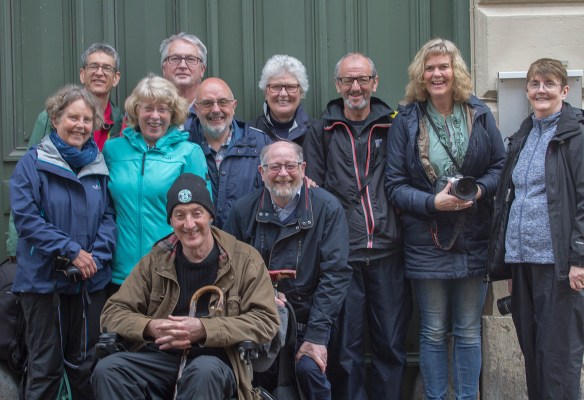
Musselburgh Camera Club and Molnlycke Fotoklubb members enjoying their tour of Gothenburg. Back row: Martin Lunden, Jan Arell (“Reluctant Chairman” of Molnlycke), Liz Sowler, George Todd, Agneta Dellefors (our street photography guide), Jennifer Davidson. Middle row: Helen Lunden, Patricia and Ken Sharp, George Smith. At the front: Kevin Johnston. Photo credit: Joe Fowler.

An enjoyable morning was followed by lunch then a few hours free time to wander around Gothenburg. We were picked up by Fotoklubb members on Sunday evening and driven out to the beautiful old school in the country east of Gothenburg where they hold their meetings. Now we know where all the images of misty lakes and birch trees come from. A Swedish supper was followed by a relaxed fun competition and lots of laughter.

It was a very busy weekend and all went very well, apart from one or two hiccups. Everyone enjoyed meeting Mölnlycke members and they seemed to enjoy having us there. Joe is hoping to do a presentation of images taken by Musselburgh members during the visit later in the year, if we can find a slot in next season’s club programme.

18 April 2019 (Club Photoshoot at Newhailles)

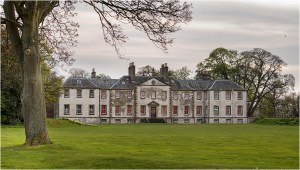
On Thursday, 18th April the annual club photoshoot took place at Newhailes House & Gardens, just to the west of Musselburgh. Fortunately, the Easter egg hunt scheduled to start on the Friday had not altered our plans and the estate was open as usual. The estate contains some woodland paths where there were glades full of bluebells, anemones and flowering garlic. Some of the flowers were protected behind a fence, but still accessible with a long lens. There were views of Newhailes House through the trees (left) and architectural focal points along the paths. Towards the end of the evening we photographed the setting sun reflected in one of the windows (right).

If anyone captured some good images on the estate, please email them to Newhailes@nts.org.uk. The National Trust are always interested in new and interesting images taken at their properties.

The next event due to take place at Newhailes is a 1745 Battle Reenactment on 25-26th May 2019. This could be another good photographic opportunity.

The next meeting at Fisherrow will be our club AGM at 19:30 on Thursday, 25th April 2019. There will be some unexpected surprises! Please come along, have a say in how your club is run and join in the fun. Refreshments will be served and trophies will be presented to the competition winners.


11 April 2019 (Best Print Of The Night)

This week was our last event at Fisherrow before the AGM on 25th April. It was an opportunity for members to bring in 1-3 prints each for an informal knock-out competition. It is an opportunity to bring along extra prints that were made earlier in the year but not used, or to try out some new images as prints. There were a wide variety of subjects: photographs of butterflies, flowers, landscapes, architecture, some beautiful portraits and some abstract images. Charlie Briggs raised a laugh with his image of a boy and a T-rex entitled, “We Should Have Bought Him A Dog”.

Prints were pitted against one-another in 3 knockout stages, in which the chairman (aided and abetted by Mike Clark) showed a remarkable inability to divide a number by 2! There was some resurrection rounds where the best images that had been eliminated could be restored and voted on again, and an image of Cove Harbour ended up ping-ponging between the two piles. At the end of the voting, members’ favourite images were as follows:

  • Equal 4th place
    • Glass winged butterfly (Robert Wilson)
    • Abstract (Kevin Johnson)
  • 3rd place
    • A misty sunrise landscape (Robert Wilson)
  • 2nd place
    • A group of harebells (Robert Wilson)
  • 1st place
    • An image of a farrier at work (Joe Fowler)

Well done to Robert Wilson for getting all three of his images into the top 5, and for securing 2nd and 3rd places! Also well done to Joe for winning the competition and taking home the box of chocolates.

Many more prints were submitted this evening than were brought to the Photo Advice Night earlier in the year, so I hope members also got some useful feedback and advice during the discussion over tea.


21 March 2019 (Set Subject Competition – Street Photography)

This week our 3-part set subject competition reached its climax with the final competition on the subject of street photography, judged by Stephen Williams, the winner of last year’s competition. Stephen began by describing his vision of what street photography means: a candid style of photography which documents human life in the street or elsewhere. He will be looking for photographs which show emotions, interactions and actions and which tell a story. The subject works equally well in colour or black and white. 18 members entered a total of 54 images. Most of the images showed people or street performers going about their business. Jim Tod’s image “Photobombed” raised a laugh, showing a lady taking a selfie with a pigeon sitting on her head! In most competitions the judge would recommend cropping out unwanted distractions but in this competition there were many images that were too tight in the frame and needed to show more of the scene to tell the story. Is this person really a hat seller if there are no hats in the picture? Who is the artist painting this picture? Where is the audience interacting with this performer? Some images with distracting colours would have worked better in black and white, although Steve Barber’s “London Transport” had been colour-popped to good effect. There were some beautiful portraits, creative abstract images and stark images of buildings, urban landscapes and street furniture which were good images but were lacking the story needed to make a good street image. The best images were the ones which captured a moment in someone’s life and made the viewer think. The top scoring images were:

  • Scrap Lady (George Todd) – 20 points
  • Edinburgh’s Finest (Mike Clark) – 20 points
  • Resting (Jennifer Davidson) – 19 points
  • London Transport (Steve Barber) – 19 points
  • Levitating Band (Steven Beard) – 18 points
  • Mobile Sweet Shop (George Todd) – 18 points
  • Pushy Lady (Mike Clark) – 18 points
  • Out shopping (Catriona McKay) – 18 points
  • View From Up Here (Gordon Davidson) – 18 points
  • Waiting (Steve Barber) – 18 points

There was a spread of high scoring images amongst all members, but it was those who were consistent who achieved the better overall score. The highest total scores were:

  • 5th place (47 points)
    • Lorraine Roberts
    • Jim Tod
    • Catriona McKay
  • 4th place (49 points)
    • Steven Beard
    • Gordon Davidson
  • 3rd place (51 points)
    • Mike Clark
  • 2nd place (52 points)
    • Jennifer Davidson
  • 1st place (53 points)
    • George Todd
    • Steve Barber

Congratulations to George Todd and Steve Barber for their joint win. In this situation the winner who did better in the other two competitions is the one who judges next year, which makes Steve Barber next year’s judge.

The final result of the 2018/19 set subject competition looks like this. The trophy is won by the member who (unless judging) has entered all 3 competitions and has the highest combined score in their two best competitions. The top overall scorers are:

  • 5th place (100 points)
    • Mike Clark
  • 4th place (101 points)
    • Jennifer Davidson
    • Gordon Davidson
  • 3rd place (102 points)
    • Steven Beard
  • 2nd place (103 points)
    • Steve Barber
  • 1st place (112 points)
    • Jim Tod

Nobody managed to get a high enough score to overturn Jim Tod’s lead from the first two competitions, so Jim wins the trophy. Also well done to Steve Barber, who moved up to take the silver medal. It is also good to see Sandra Crowhurst, Catriona McKay and Gordon Davidson submitting some really good images to this competition.


21 February 2019 (Human Portrait Print Competition)

Here, at last, are the results from the human portrait competition which took place on 21st February 2019. The competition was judged by Neil Spowart of North Berwick Photographic Society and the results read out on the night by Mike Clark. I missed the competition but I understand Mike put on a good show for those present.

35 images were entered by 12 members. The top scorers were (in reverse order):

  • 4th place (51 points)
    • Malcolm Roberts
  • 3rd place (52 points)
    • Jennifer Davidson
  • 2nd place (53 points)
    • Jim Tod
    • Steve Barber
  • 1st place (59 points)
    • George Todd

Well done to George for winning the competition with an almost perfect score! The top images were:

  • Yadana (George Todd) – 20 points
  • Baraha Temple Priest (George Todd) – 20 points
  • Blue Rinse (Malcolm Roberts) – 19 points
  • Marching To My Fate (Jim Tod) – 19 points
  • Distracted (George Todd) – 19 points
  • Balancing Act (Jennifer Davidson) – 18 points
  • Andy (Jim Tod) – 18 points
  • Arms (Kevin Johnson) – 18 points
  • Halloween (Steve Barber) – 18 points
  • Mysterious Lady (Steve Barber) – 18 points