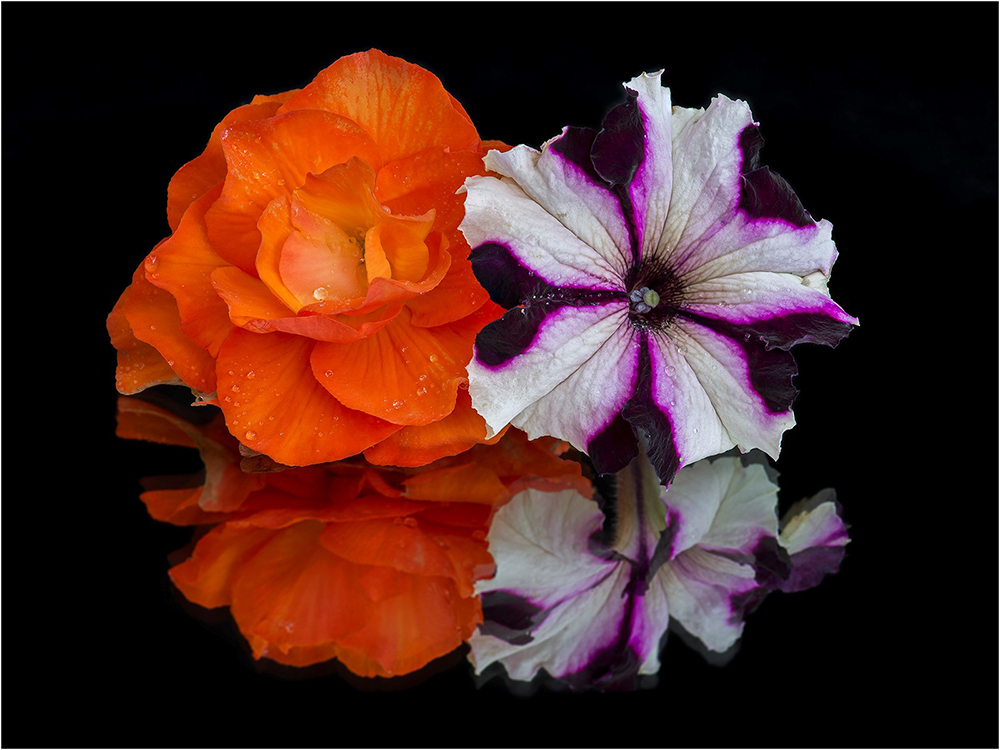
25 January 2024 (Sets of Six and Macro Presentation)

This week we had a “Sets of Six” evening, where members bring along images or give interesting demonstrations. I started the evening by giving a macro photography demonstration. I brought along a small (25cm x 25cm) lightbox into which I placed a “Musselburgh mussel” on a stand.

Macro photography is extreme close-up photography where the original idea is was to make the image on the camera’s sensor at least the same size as the subject itself. To achieve this you need a lens which can focus very close. A macro lens is one designed to have a close focus distance for macro photography, but if you don’t have a macro lens (or want to try macro photography at a different focal length than your macro lens) the following gadgets can also help:

  • Extension tubes will reduce the focal distance when fitted between your camera and lens. These are the best option because they contain no glass and won’t affect the performance of your lens. But make sure you buy ones compatible with your camera.
  • Close-up lenses can be screwed to the front of your lens, just like a filter. These have the advantage of being cheap and easy to fit, but because they contain glass they affect the performance of your lens.

One of the most difficult things in macro photography is getting the focus right. Macro photos tend to have a very narrow depth of field, especially if you choose a longer focal length to keep clear of your subject. One way to correct the narrow focal length is to use a narrow aperture (such as f/16 or f/22) but that leads to a longer exposure time and motion blur. Good lighting is very important in macro photography. For still subjects you can use a light box. Click here to see a review of the one I demonstrated, but there are other makes and sizes available. For moving subjects you can use a ring flash which fits on the front of the lens, which won’t cast shadows like a flash attached to the camera body. If you are lucky enough to have bright natural light available, a small reflector or diffuser can be used to soften the lighting and brighten the shadows. A gadget, such as a Wimberley Plamp, can be attached to your tripod to hold subjects like flowers that might be blown by the wind.

Another way to achieve a better depth of field in macro photography is using a focus stacking. Here is a YouTube video which explains how to do it.

You can change the focus by using the focus ring on your lens, but some photographers find a focus rail (which moves the camera back and forth on a rail) is easier to control. This site shows you how use a focus rail: https://www.digitalcameraworld.com/tutorials/how-to-use-a-macro-focusing-rail-for-a-focus-stacked-close-up.

Finally, I demonstrated a USB microscope, which can produce extreme macro close-ups. The depth of field for these devices is extremely narrow and they work best with two-dimensional subjects. But they can detect tiny objects invisible to the naked eye, such as dirt on the front of your lens you didn’t know was there. Here is a review: https://gadgets-reviews.com/uk/review/1388-best-usb-microscopes.html. These range from cheap to very expensive. I demonstrated a mid-range Jiusion microscope which saves HD images.

Several members then showed a selection of interesting images: Kevin Johnson showed how classic album cover art can inspire photography; Mike Clark showed some “before and after” results in underwater photography; John West showed how you can use ICM to transform an image of the interior of a cathedral; Malcolm Roberts described his visit to the Wildlife Photographer of the Year exhibition; There were also some unique views of The Kelpies. George Smith showed his first attempts at astrophotography; Elaine Gilroy showed her photographs of birds; George Todd showed a selection of holiday images; and Derek Muller showed a rig he had set up to capture water splashes. Derek also showed some of his favourite images of acorn people created by David M Bird. More of these images can be found on David’s YouTube channel:

https://www.youtube.com/@davidmbird

Finally, Joe Fowler showed us how images can be improved by removing the distractions and using the clone tool to add more interest. Thank you to everyone who showed their images. It was a long but very entertaining evening.

Next week we have a digital knock-out competition. Please bring up to 3 images on the subject a “water” and then vote for your favourites.

08 December 2022 (Julian Elliot: Breathless in Nepal)

Our last meeting before Christmas was another joint Zoom talk hosted by Beeslack Penicuik Camera Club and joined by Earlston Camera Club members. Julian Elliot, an award-winning landscape and travel photographer, connected with us from France and gave us a fascinating talk about his experiences. You can find more about Julian on his web site:

https://www.julianelliottphotography.com/profile/

Julian began his talk by describing his kit and explaining his techniques. He normally travels with a Canon DSLR camera plus 6 lenses (3 zoom lenses and 3 tilt/shift lenses), although 90% of his travel photography is made with the following gear:

  • A 24-70 zoom lens. Julian finds this lens makes great portraits, and is also useful for landscapes and use in cramped spaces. He likes to photograph hands with this lens.
  • A 100-400 zoom lens. Julian uses this lens to make landscape images of distant mountain scenery. Some people are surprised that a telephoto lens can be used for landscapes, but mountains tend to look more impressive when the depth is compressed. The lens can also pick out interesting details from the landscape. Julian also uses this lens to make panoramas, and to take distant portraits with a compressed background.
  • A 24 tilt-shift lens. Julian finds a tilt-shift lens invaluable for photographing architecture. It gives superior results than taking a picture with a normal lens and using a lens correction filter because you can see the result you are going to get in-camera, and there is is no cropping of the image at the edges. Julian showed some examples of what could be done with this lens: a superb shot of the inside of a cathedral, or a photograph of a statue in front of a temple taken from only a few feet away with all the verticals vertical.
  • A 1.4x extender, which Julian uses to extend the capabilities of the above lenses/
  • A carbon fibre tripod (lightweight for travelling).
  • A polarizer filter and a neutral density filter. Polarizer filters can enhance the sky or remove reflections, and the neutral density filter allows longer exposures.
  • A decent camera bag. Julian explained that most bags are designed to be used in an airport, and it is hard to find a bag that is versatile enough to use on a flight and carry outside.

Julian went on to explain how he plans his travels. He learns about destinations by reading travel magazines and using travel guides for research. He looks at photographs published by other photographers to get an idea of the possibilities. You can follow particular photographers on social media, but you can also follow specific hashtags, such as “#vietnam”, to see all the posts made about a particular place. But he warned us that landscapes are constantly changing. What you see described in a guide or shown in a past photo might not be there any more, so be prepared for the unexpected. He uses the following tools to plan his shots:

  • Google street view can be used to explore a destination virtually, but not all countries allow it.
  • Once Julian has decided on a destination, he uses Google Mind Maps to plan his travel. It can be linked to maps, and the application can be used on a phone to create an itinerary.
  • The Photographer’s Ephemeris can be used to plan your shots and investigate where the light will come from at different times of the day. The PhotoPills application is also a very useful planning tool.

After taking us through the basics, Julian then took us on a journey to Upper Mustang in Nepal, showing us the spectacular landscape images he had take on the trip, the portraits of the people he had met on the way, and his architectural photographs of the towns and temples. Travelling to Upper Mustang was like travelling back in time, with very different norms and customs. He became friends with a local guide who introduced him to interesting people. Julian would often ask permission to take his shots from unusual vantage points, such as the roof of a temple. On his journey through Nepal, Julian needed to climb to some high altitude view points, and on one of these excursions he suffered from serious altitude sickness. Julian told us the story of his treatment and recovery and warned anyone else travelling to Nepal to be aware of the effects of the altitude and not to push themselves too quickly. Julian finished his presentation with a selection of portraits and images of more spectacular temples. It was a very entertaining and enlightening evening.

That was the last club meeting at Fisherrow until the New Year. Next week we will be meeting at the Ravelston House Hotel in Musselburgh for the club’s Christmas social evening.

Steven