Unknown's avatar

About stevenmbeard

I am the chair of Musselburgh Camera Club, and also a software engineer at the UK Astronomy Technology Centre in Edinburgh.

08 October 2020 (Digital Projected Images Competition)

This week the club had its first competition of the season, and the first ever competition judged virtually from our own homes. We were pleased to welcome Dougie Allan from Beeslack Penicuik Camera Club. Dougie also took the opportunity to show us some more of his impressive drone photography.

There were 54 images altogether, covering a wide range of different subjects. The pictures included landscapes, sporting events, portraits, wildlife, flowers and some interesting abstracts. Dougie commented on the composition, sharpness, focus and depth of field of each image. There were some lovely compositions which were not sharp and some sharp images that were let down by distracting elements in the composition. A shallow depth of field can be good at reducing distractions from background objects, but it doesn’t help if those distracting objects are brightly coloured (like a red mushroom or a yellow wheel). Some images needed a larger depth of field to keep more of the subject in focus and some images could have been improved with a longer exposure time (to add motion blur or to blur the water). Dougie also mentioned that some images, where the subject was dark against a light background, could have been improved by adding light from a flash or reflector. There were also some fantastic shots where all the elements worked, and these images gained the highest marks. The virtual nature of the presentation, with everyone muted, meant the top scorers didn’t get the loud applause they all deserved. The top scorers were (in reverse order):

  • 5th place (51 points)
    • John West
  • 4th place (53 points)
    • Mike Clark
  • 3rd place (54 points)
    • Joe Fowler
    • Steven Beard
  • 2nd place (57 points)
    • Gordon Davidson
  • 1st place (58 points)
    • GeorgeTodd

The top images were:

  • Making a Splash (Joe Fowler) – 20 points
  • Hare on the Move (George Todd) – 20 points
  • Calton Hill (Gordon Davidson) – 20 points
  • Making an Exhibition of Yourself (Steven Beard) – 19 points
  • Tearing up the Track (George Todd) – 19 points
  • Taking the Last Jump (George Todd) – 19 points
  • Forth Bridge at Sunrise (Gordon Davidson) – 19 points
  • Royal Highland Show (Steven Beard) – 18 points
  • Roe Deer Buck Portrait (Mike Clark) – 18 points
  • Shipwreck Sunset (Mike Clark) – 18 points
  • Wallace Monument at Dawn (Gordon Davidson) – 18 points
  • Stretching Time (John West) – 18 points

Well done to George Todd for winning the competition with only 2 points short of a perfect score.  And well done to everybody else who entered. There was an improvement in image quality across the board this year. A newcomer who is improving today can be a winner of the future.

Next week we will go through the competition images a second time, with more opportunity for feedback and questions.
01 October 2020 (Photo Advice Evening)

On 1st October we had our first virtual photo advice evening. Normally we would sit around tables in the Fisherrow Centre and discuss the prints brought by members, passing the prints from table to table, and finish the evening with a chat over tea and biscuits. This year we discussed digital versions of our images by Zoom teleconference. Each member presented 3 images for comments and advice. Unlike the photoshoot round-up last week, this time we spent much longer on each image discussing its merits and suggesting improvements. Some of the lessons learned were:

  • Macro photography is difficult and focusing is critical. If you are close to your subject even small camera movements can shift the focus away from your subject. Flowers blowing in the wind can drift in and out of focus as they move, and you if you choose a smaller aperture to give a greater DOF the wind can cause motion blur. Macro photography is best done using a tripod in a sheltered spot. Hand-held macro shots let you be more creative, but you should allow for a lot more rejected shots.
  • A focus stack is difficult to get right, but small focus increments work best, and the shots are best made using a tripod. Try taking a test shot at a very small aperture (such as f/22-f/32) to see how your subject looks with a large DOF. The focus stack will have worked if you can create a sharper shot than the one taken at the very small aperture. (Shots at very small apertures are blurred by diffraction.)
  • A landscape image works best when there is something interesting in the foreground, such as a house, a river or a path which leads the eye to the interesting scenery in the background. It is well worth collecting photographs of interesting skies, even if the foreground is boring. You can replace a boring sky in a landscape shot with an interesting one from your collection.
  • Nature and wildlife images work best when there is a narrow DOF and no distracting objects in the background. Ideally, distractions should be avoided by careful composition in camera but we don’t always notice everything at the time. Distractions can be cropped out or darkened or (for nature photography only) removed by cloning. These days, the most successful nature and wildlife shots are ones that capture interesting or unusual behaviour.
  • Shots made at unusual angles can work really well. Try getting down on the ground and photographing your flowers from their level, or capturing a crabs-eye view of the shells on a beach.

Thank you to everybody who brought and shared their images. There were some really cracking flower and nature shots we may well see again in future competitions.

  • Next week we have our first competition of the year. Dougie Allan will judge our Digital Projected Images Competition. Our first virtual competition. I look forward to seeing you then.


24 September 2020 (Outdoor Photoshoot Roundup)

On 24th September club members met to discuss their experiences visiting the The Royal Botanical Gardens in Edinburgh.  Members had visited the gardens on different days and at different times, and had photographed the plants and flowers under different lighting conditions. We took turns to show the images we had captured during our visit. We quickly discovered the following subjects had attracted attention and been independently photographed by members in different ways:

  • The young moorhen in the pond.
  • The plants growing in the rock garden.
  • An inquisitive squirrel.

There were lots of photographs of flowers and wildlife, photographs showing the texture of tree bark and photographs showing the natural patterns made by leaves and foliage.  There were also some photographs of the patterns created by the flotsam in the pond, and a lovely photograph of the Chinese pavilion.

This was our first practice at screen sharing in Zoom and it worked.


10 September 2020 (Extra Club Meeting)

We are starting the 2020-21 season two weeks later than usual. There has been a lot of uncertainty over the summer about whether or not the Fisherrow Centre would reopen, and exactly how many of our meetings we would need to hold by Zoom videoconference. This extra club meeting was arranged by Zoom to inform members about the latest news. Here is a summary:

  • The club needs to follow guidance for keeping members safe during the covid-19 pandemic. The situation is changing constantly and members are advised to monitor the web site and watch out for club emails to be informed of last minute changes. You can find some guidance at the following links:
  • Existing members can join the club by emailing the treasurer, returning an application form and paying their membership fee by bank transfer or cheque. New members can contact the club secretary (as stated on the home page) and will be referred to the treasurer.
  • The Fisherrow Centre is closed until further notice, so all our meetings will be held by Zoom unless otherwise stated. I have created two sets of recurring meetings for members:
    • A meeting at 19:30 every Thursday for our regular club meetings.
    • A meeting at 19:30 every Tuesday for extra meetings such as training sessions.
    • When members join the club they will be given the information needed to join these two meetings. However, we can create as many meetings as we like, and the club is not limited just to these two occasions.
    • Haddington camera club have kindly provided a link to this article describing how to use Zoom:
      https://www.businessinsider.com/how-to-use-zoom
  • There has been a change to the club rules for Digital Projected Images. All images must now be no wider than 1600 pixels and no taller than 1200 pixels. The matches the club rules to Scottish Photographic Federation (SPF) rules.
    • The deadline for submitting images to the DPI competition is Thursday 17th September. Please email them to georgetodd1957@me.com.
  • Print competitions will take place digitally until further notice. Judges will accept images digitally, but they must be sized to the same limits as DPIs.
    • Members can add a small border to indicate how they would have mounted their image, but this is entirely optional.
    • Because of the image size limit, use a thin border, not the thick border demonstrated in my previous club message.
  • We would like to arrange regular photoshoots so that members have an opportunity to meet face to face outdoors. The following venues were suggested:
  • The maximum limit of 6 people from 2 households meeting up will make photoshoots more difficult but not impossible. We can follow this procedure:
    • The club advertises a venue and a 2 hour time slot.
    • Members make their own arrangements and visit the venue during that time slot.
    • Up to 6 members from 2 households can arrange to meet up.
    • After the visit we meet together by Zoom, show our pictures and compare our experience.
  • The recent change in the rules on meeting people in Scotland means that next week’s opening night and trophy presentation cannot take place face to face. Instead, George will present the trophies virtually and will arrange to have them delivered to winners.

The real start of the club season begins next week with our opening night and long overdue presentation of the trophies from last year. I look forward to seeing you again (albeit through a computer screen).

How to Make a Digital Print

Our new season is fast approaching. This season, because of covid-19 restrictions, it is likely that many of our print competitions will need to be held digitally. Our judges have agreed to accept digital versions of images and judge them as if they were prints.

So how do you distinguish a print competition from a digital projected image competition if both competitions are judged digitally? Well, one of the differences in a print competition is choice of mount: its colour and size relative to the print. For a digital competition you won’t be able to physically mount your prints, but you can make it look like they have been mounted. The following presentation shows you how to do it using Photoshop.

HowToPrepareADigitalPrint

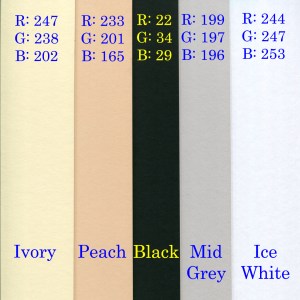
Here is a mount-board swatch I created by scanning samples of my own mount-board. If you have a different selection of favourite mount-board colours, you can scan or photograph samples of your own to make a similar swatch.

Of course, with “digital” printing you can create a mount-board in any colour you like!

I look forward to see you all at this Thursday’s extra meeting and welcoming you to the start of the new season.

27 February 2020 (3-Way Inter-club Competition)

This week Musselburgh Camera Club hosted the first of a new series of 3-way competitions with Beeslack Penicuik Camera Club and Haddington Camera Club. I was disappointed to miss this competition myself, due to a late night at work. I would like to (belatedly) welcome Beeslack and Haddington to Musselburgh and hope they enjoyed the homemade cakes that we usually lay on for such occasions.

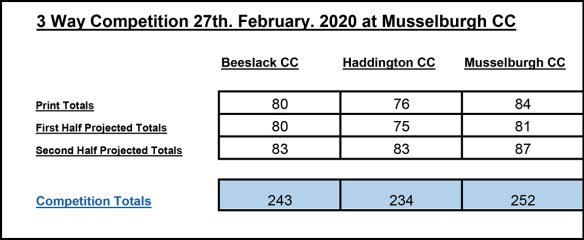
The competition was judged by Doug Bernt from Edinburgh Photographic Society. I heard that Doug picked up on every detail that he thought would improve the images submitted. Each club submitted 5 prints and 10 digital images each, and the competition was split into 3 stages: 15 prints followed by the first 15 digital images, then the remaining 15 digital images. Musselburgh Camera Club submitted the best print (Taj Mahal “Before The Crowds”), but Haddington Camera Club submitted the best digital image (The Green Dress).  The final scores were as follows:

The top Musselburgh images were:

  • Taj Mahal “Before The Crowds” (print) – 20 points
  • Tanahun Priest (print) – 19 points
  • Loch Ard Boat (DPI) – 19 points
  • Pelican Reflection (DPI) – 19 points
  • Razorbill (DPI)
  • Magnificent Hummingbird (DPI) – 18 points

Thank you to Doub Bernt and well done to Musselburgh Camera Club for another decisive win!

20 February 2020 (Photographing Scotland)

This week we had the pleasure of welcoming Scottish landscape photographer Dougie Cunningham, author of the popular guidebook “Photographing Scotland“. Dougie began by telling us how he started in photography, which grew out of his love for the outdoors and the satisfaction of capturing those defining moments in life. He shot wedding photographs for friends and worked on photo-shoots for outdoor clothing manufacturers. His full biography can be found on his website, “leading lines”:

https://www.leadinglines.net/bio

Dougie then described how his love for landscape photography turned into a contract to write a guidebook for photographers wanting to capture the best Scotland had to offer.  The book was divided into chapters covering different parts of Scotland. Compiling each chapter became an adventure in itself. Some chapters were completed quickly and some chapters needed many repeated visits to the same location until the weather finally allowed Dougie to capture the shots he wanted. Dougie toured Scotland in a small camper van, which allowed him to sleep in remote locations and wait for the sunrise.  A typical pattern was to capture sunrise and sunset, then drive to the next location and wait for the next sunrise. He would often climb to the top of a mountain and sleep in a tent at the top, hoping to capture a striking sunrise shot from the summit, only to wake in the morning after an uncomfortable night to the sound of horizontal rain lashing against the side of his tent. But Dougie learned during the project to make use of every opportunity; not to let tiredness put you off when the light is right, and not to let waking up to bad weather put you off. On some occasions the weather had cleared enough by the time Dougie set up his equipment to capture an atmospheric post-storm mountain sunrise. He found the project itself gave him the inspiration to keep going. In landscape photography it helps to give yourself a goal.  Members were transfixed for an hour and a half, when Dougie showed one spectacular Scottish landscape image after another.  Some of these images can be seen in Dougie’s flickr collection:

https://www.flickr.com/people/oldnotbold/

Dougie described some of his photography techniques. He tries to capture scenery as you would find it, so his photographs are not digitally manipulated (apart from graduated filters and tone corrections). If a lamp post happens to be in an inconvenient place, so be it. But this rule helps Dougie think about the composition of his images, capturing iconic landmarks from unusual angles to avoid the distractions. Dougie encouraged photographers to find new ways of capturing popular scenes. It is understandable for a someone visiting a place for their one and only time to play safe and capture the usual postcard shot, but if you have a chance to visit more than once it pays to experiment and find a new view unique to yourself.  Dougie’s book can be found in most bookshops, such as those below:

Amazon;  W H Smith; Waterstones;  Blackwells

Now we just need to save up and buy that camper van…


13 February 2020 (Set Subject Competition – Wildlife)

This week we had the second of our 3 set subject competitions; this one on the theme of “Wildlife”.  Jim Todd had won last year’s “Abstract” competition but, as he was already judging the “Travel” competition, the judging passed to me in second place. Wildlife photography is one of the most strictly-defined categories. A commonly accepted definition is

Wildlife photography is a genre of photography concerned with documenting various forms of wildlife in their natural habitat.

Competitions such as the International Wildlife Photographer of the Year or Scottish Nature Photography Awards define strict rules along the lines of:

  • The photograph must include a wild creature and not a pet, a tame or farm animal. The creature must also be alive.
  • The photograph must be taken in the wild and not in a zoo, farmyard or any place where animals are in captivity.  N.B. A local park or garden is regarded as a wild place.
  • You must not manipulate the photograph in any way which changes the environment or animal but you are allowed to correct what the camera has done to the image. Cropping, colour correction, brightness and contrast correction, dodging, burning and removal of dust spots is allowed but cloning out distractions or composing composite images is not. Organisers will want to see the original RAW file from your camera as proof. So, if you capture a fantastic wildlife shot and are considering entering it for one of these competitions, keep your RAW file.

The club competition was not judged as strictly as these competitions. All images were accepted. Judging what was wild lead to a few controversial decisions: Is that curled up animal a domesticated cow or a wild deer? Did the photographer stalk that tiger, take a close-up photograph and survive, or was the image taken in a zoo? There were 45 images entered by 15 members. It was a hard competition to judge because all the images were good in some way. The strongest images were the ones which captured a wild animal showing natural behaviour, and where the background showed the environment but wasn’t too distracting from the subject. Photographs taken at eye level gave more engagement with the viewer than ones pointing downwards or upwards (although Mike Clark showed that rule could be broken with a shot of a Sparrowhawk looking directly down from a tree at the photographer). Cropping too tightly was a common fault. Some images were also take in harsh lighting. Correcting the exposure, dodging and burning can help some of these images, but choosing a cloudy day rather than bright sunshine would help capture a better image in camera.

The top-scoring images were

  • Red Squirrel (Jennifer Davidson) – 20 points
  • Where’s Dinner? (Joe Fowler) – 19 points
  • Female Green-Breasted Mango (Anne Yeomans) – 19 points
  • Robin Redbreast (Jennifer Davidson) – 18 points
  • Queens Of The Road (George Todd) – 18 points
  • Sparrowhawk Eyes Locked On (Mike Clark) – 18 points

The highest scorers were:

  • 5th place (47 points)
    • George Todd
  • 4th place (48 points)
    • Malcolm Roberts
  • 3rd place (50 points)
    • Mike Clark
  • 2nd = place (52 points)
    • Joe Fowler
    • Anne Yeomans
  • 1st place (55 points)
    • Jennifer Davidson

Well done to Jennifer Davidson, who wins the privilege of judging next year’s competition. The league table after two competitions has narrowed and now looks like this:

George Todd (55 + 47 = 102)
Joe Fowler (49 + 52 = 101)
Mike Clark (51 + 50 = 101)
Anne Yeomans (47 + 52 = 99)
Malcolm Roberts (50 + 48 = 98)
Lorraine Roberts (49 + 45 = 94)
Gordon Davidson (49 + 45 = 94)

Only 4 points separate the top 4 places, so there is everything to play for.  Entries for the final set-subject competition (on the theme of “Old Faces”) are due on 5th March 2020. Best of luck everyone!

30 January 2020 (Human Portrait Print Competition)

This week we had the last print competition of the season. Roger Stewart, vice president of Stirling and District Camera Club, visited Musselburgh to judge our human portrait print competition. Roger specialises in wildlife and landscape photography. Click here to see his gallery.

Ten members had entered 30 prints, which was a smaller entry than usual, but this gave Roger more time to critique each print. Most of the entries this year were portraits of individuals, but there were a few group photos, and it was a group photo of three people having fun in the water which won the evening. Some of the portraits were a little too tightly cropped, and Roger recommended allowing a little more space so that a piece of hair, or the very top of a hat, is not cut off by the frame. The depth of field was an issue in some images. In a portrait the eyes must be sharp, but there were cases where the camera had focused on a nearer part of the face, leaving the eyes soft. Portraits that were not face-on posed a particular problem. If your subject is sitting at an angle you’ll need a larger depth of field to keep everything of interest in focus. The title of the print can also suggest what needed to be in focus. For example, if the title suggests the subject is writing a letter, both the eyes and writing hand need to be in focus. Likewise, a portrait entitled “Wink” leads to a dilemma over whether the open eye or the closed eye should be in focus. Settle the dilemma by keeping them both sharp. Brightening the eyes and face can also help improve a portrait. Distracting backgrounds were a common problem, and Roger suggested whether a different angle of view could have helped.

The top scorers in the human portrait print competition were (in reverse order):

  • 4th place (46 points)
    • Jennifer Davidson
    • Malcolm Roberts
    • Sean Conner
  • 3rd place (48 points)
    • Joe Fowler
  • 2nd place (49 points)
    • Steven Beard
    • John West
  • 1st place (53 points)
    • George Todd
    • Mike Clark

and the top images were:

  • Bursting With Happiness (Mike Clark) – 20 points
  • Brahman Priest  (George Todd) – 19 points
  • Fortune Teller (John West) – 19 points
  • Tanahun Priest (George Todd) – 18 points

Well done to George Todd and Mike Clark, who now need to decide how to share the trophy. Congratulations also to relative newcomer John West for a great result.


Astrophotography: How do you find out what’s up there?

I was asked if there are resources that will tell you what is coming up in the sky, so you can make plans for astrophotography. The answer is sufficiently useful that I thought I would post it to everyone. I think the very best web site for planning astrophotography is this one:

https://www.heavens-above.com/

Click on the link and you have a large number of options. I have programmed the above link to select “Musselburgh” as the default location. Click on “location” in the top right corner to see what the sky is doing where you live. The site is used by amateur astronomers, satellite and space enthusiasts, but the pages I think would be most useful for astrophotography are:

  • Interactive Sky Chart: This tells you what the sky looks like on any date. The zenith (looking straight up) is in the middle of the graph and the horizon is around the edge. Change the date to see how the sky will change in the future. You can, for example, see where the Milky Way crosses the horizon on each date. You can follow the planets and see if there are dates when they clump together and make a show at sunset or sunrise.
  • The Moon: This page lets you follow what happens to the Moon on future dates. You can check its phase and check when it might pass close to a planet and make a good show. For example, dial up 28th January 2020 and press “update” and you’ll see the crescent Moon passes close to Venus. If the sky is clear this would  be a good time to photograph the Moon as it sets.

Another very useful site is this one:

https://www.timeanddate.com/

The first thing you’ll need to do is click the “set home location” link under “Set time” and set your home location to Edinburgh, Scotland (it doesn’t know about Musselburgh). This site doesn’t have as many features as heavens-above, but it is is best site for predicting eclipses. Click here to bring up the eclipse planning page. The site is not as good at remembering your location, so make sure you type “Edinburgh, Scotland” in the “Place or country” box to get the correct information. You’ll find the next eclipse visible from here is a rather boring penumbral lunar eclipse on 5th June 2020. Keep tracking forwards and you’ll see there is a good solar eclipse on 10th June 2021. Put that date in your diary.

Finally, another site I find useful is this one:

https://spaceweather.com/

The site is dedicated to monitoring solar activity, so it is a good place to get sunspot and aurora predictions. The site doesn’t plan ahead but tells you what’s in the sky right now. It’s a good place to see alerts about aurorae or unusual clouds that could make interesting landscape images. Best of luck!

I hope all this will be useful to some members.