03 March 2022 (David Clapp: Landscape and Travel Photography)

On 3rd March 2022 we joined Beeslack Penicuik Camera Club for a joint session by Zoom, which once again let us to connect with a photographer from further afield. This time we were joined by David Clapp, a successful travel and landscape photographer from Newton Abbot, England. David said he started photography in 2002/2003, at first capturing images on film before moving on to digital photography. He started as a guitar teacher but his interest in photography lead to a career as a full-time professional in 2009. He has contributed travel photographs to guide books and stock photos to Getty Images. David explained that he doesn’t like the “instant gratification” aspect of social media. He prefers people to take more time and enjoy photography as an artform. You can see and enjoy David’s images one his website or his teaching page:

/https://www.davidclapp.co.uk/

https://www.westdean.org.uk/study/tutors/david-clapp

David began by showing us a trick he uses to select the best compositions from a vista. If he finds himself looking at a panoramic landscape he takes a series of, say 7, overlapping shots in portrait mode and then blends them into a large panorama. He can then crop out smaller compositions from this large image. Shooting in portrait mode means you don’t lose resolution when extracting portrait-format subsets. David suggested that the best way to progress in photography is to take risks. Take photographs that mean something to you, rather than photographs designed to please your peers. David took a risk when he converted one of his cameras to infrared photography, but it paid off. He showed us some stunning images of gnarled trees photographed around Dartmoor. The shots looked like snow scenes, but were in fact taken on a misty summer day with the infrared-converted camera.

David explained the composition of his landscape images and illustrated each composition by drawing “force lines” which represented the leading lines which your eye tends to follow. The strongest compositions have “force lines” which come in from a corner and lead you to a focal point. He tries to place focal points either on a 1/3rd or in the middle. Lines which criss-cross the image give it more complexity. David also showed how a balanced image would look more pleasing to the eye. He arranges to have the same-sized gap on the left and right sides and at the top and bottom of each image. He finds the most pleasing compositions are made at moderate focal lengths, and finds a 35-70mm lens ideal for landscape photography. A few years ago everyone tried to capture the “rock in the foreground” shot, where a wide angle lens captures a huge vista stretching from a rock in the foreground, to some trees in the middle ground and then mountains in the distance. Such a shot can capture the attention at first, but your brain tends to lose interest because too much is included and the foreground objects dominate the shot. David prefers to take landscape shots of specific objects within their surroundings, such as the trees in Dartmoor, rock formations on the top of a hill, or farm buildings within a farm. He recommends avoiding focal lengths wider than 35mm.

David described the method he uses to capture the best landscape shots. He avoids using a tripod (unless deliberately making long exposures at night) and instead takes hand-held shots at a high ISO setting. A tripod tends to anchor you to one spot, and David likes to look through the viewfinder, identify the key components in a scene, then move the camera until he finds a spot where the key components are spaced in a pleasing way. Try to have evenly-spaced objects in the scene and try not to have overlaps between objects. Zoom in and out and rotate the camera to find a shot where lines are anchored at the corners. If there is a building in the scene, try to include the door, and don’t turn take the shot more than 45 degrees away from that door.

David warns of falling into the trap of using excessive processing in Photoshop. Adding a colour or contrast boost to your images might make them look punchier, but it can also make them look unnatural. This is another example of spoiling images to make them attention-grabbing. David showed us the histograms of some of his images. They rarely contain completely white or completely black areas because most natural scenes don’t look completely black or completely white to your eye. This gives the images a more pleasing, natural and artistic look. Revisiting the same scenes many times in different lighting conditions will help you capture the best images.

In the second half of his talk, David gave an introduction to architectural photography, using images of the high rise buildings in Bishops Gate in London as an example. He explained how he applies the same techniques for these images. Shots of small groups of buildings work better than large cityscapes. You can even capture abstract images by focusing on just one part of a building. Upward-facing shots can be used to capture a strong perspective, with the vanishing point placed on a 1/3rd or in the middle. Try to rotate the shot so the edges of the buildings pass through the corners. Photographs of window reflections work better when there are no clouds in the sky.

Unfortunately, Musselburgh members at the Fisherrow Centre missed the end of David’s talk because of the early closing time 😦 but I understand he went on to show more abstract images captured in London and show more infrared shots.

Thank you very much Beeslack for hosting this extremely fascinating and captivating talk, and thank you David for taking the time to engage with us.
24 February 2022 (3 Way Inter-Club Competition)

The 3-way inter-club competition between Musselburgh Camera Club, Beeslack Penicuik Camera Club and Haddington Camera Club took place on Thursday, 24th February 2022. The meeting was hosted by Beeslack via Zoom, with images judged by Simon Allen from Dumfries Camera Club. Musselburgh had come 4th in the 4-way interclub competition earlier in the year, so we were eager to do better this time.

Each club has submitted 15 digital images, making a grand total of 45 images. There were landscape images, wildlife images, horticultural images and portraits ranging from characters at a battle re-enactment to a family beach holiday. The most unusual image was a stunning astrophotograph called “Cygnus Wall”, submitted by Haddington.

Simon mentioned there was a high standard of images overall. There were no bad images, and the marks represented the overall ranking of the images compared against each other. Simon commented on the composition and execution of each image. He described what he liked and didn’t like about each one. The best photographs had a clear distinction between subject and background, and images with bright distractions lost marks. But Simon pointed out that some background objects were necessary to show the whole story. For example, a portrait of a soldier would not have worked without the out of focus image of his musket. Some images had sharp edges in the background which might have been created by selections in Photoshop not being properly feathered.

Musselburgh members watched the competition either from home or from room G3 at Fisherrow. The post-competition chat had to be curtailed for those at Fisherrow because of a change to the Fisherrow opening hours (so apologies to Beeslack and Haddington that we had to leave so quickly at the end). The final scores were:

  • 1st place: Musselburgh Camera Club, 255 points.
  • 2nd place: Beeslack Penicuik Camera Club, 248 points.
  • 3rd place: Haddington Camera Club, 232 points.

So our revamped selection of images was a big success! Here are Simon’s best Musselburgh images:

  • Roe deer on guard (Jennifer Davidson) – 17 points.
  • Glenfinnan Viaduct (Steven Beard) – 17 points.
  • White Tailed Sea Eagle (Mike Clark) – 18 points.
  • Millarochy Bay Sunset (Gordon Davidson) – 18 points
  • Kalia – Green Activist (George Todd) – 19 points
  • Dreaming of days gone by (George Todd) – 19 points
  • Stylish (Carol Edmund) – 19 points
  • Mountain Gem Humming Bird (George Todd) – 20 points

Well done to Musselburgh, thank you to everyone who provided images for this competition, thank you to Simon Allen for judging it and thank you to Beeslack for hosting it.

In case you missed it

If you were not at Musselburgh Camera Club last Thursday, Andrew Lanxon Hoyle has now added a recording of his talk on “Expanding Your Mental Kitbag” to his YouTube channel:

We get a plug at the beginning. The recording shows everything except the extensive question and answer session we had at the end.

See you this Thursday for the 2-way competition.

Cheers,
Steven

17 February 2022 (Andrew Lanxon Hoyle: Expanding Your Mental Kitbag)

This week we were delighted to welcome our second face-to-face speaker of the season. Andrew Lanxon Hoyle is an Edinburgh-based photographer and senior editor for the technology publication CNET.com, responsible for shooting automotive, product and editorial images. Andrew has his own web page displaying his work, where you can find many of the images he showed us tonight.

http://lanxonphotography.com/

He is also well-known for posting photography stories and advice on his many social media channels:

In fact, you can find now a recording of his talk here:

Andrew gave us a presentation entitled “Expanding Your Mental Kitbag”. If you find yourself running out of ideas as a photographer, or are not happy with the images you are creating, it is tempting to try expanding your kitbag. Surely, buying an expensive piece of kit like a new lens will help improve your work? But Andrew pointed out that you could just end up pointing your new lens at the same subjects. Instead he recommends expanding your mental kitbag. Don’t let yourself be categorised as just one type of photographer (landscape, portrait, macro, still life, etc…) if you happen to be good at that one thing. Try new ideas, new situations and new techniques. You will find that ideas that work in one area of photography can be adapted to a new area and bring sometimes surprising results.

Andrew took us on a fascinating photographic journey from when he started with simple product photography to his later, more sophisticated use of lighting. He learned an off-camera flash lighting technique for wedding photography and then found he could use that same technique for his editorial images. Andrew’s signature is to find unusual ways of showing a subject. Where most product photographers would show someone holding a phone, Andrew would show the phone against an abstract landscape. And instead of showing a distillery manager sampling his whisky, he photographed him in the grain silo! The more techniques Andrew tried, the more he learned how to use lighting. A DJ’s spotlights could be used to make a unique wedding shot. A high speed flash can be used to freeze the motion of a water splash, whatever the shutter speed. The highlight of the evening was Andrew’s story of how he photographed the Bugatti Chiron. Instead of settling on the usual “on the road” shot, Andrew proposed to shoot the Bugatti at night against a popular landmark in Madrid. The photoshoot required a road to be closed by a police escort. The shot was created using a light painting technique where the car was lit from different angles and dozens of shots stacked together to give the final result. Andrew impressed Bugatti so much they nicked his photo. That must be the definition of success!

Thank you very much for inspiring us with a fascinating talk.

10 February 2022 (Audio Visual Evening)

This week we once again hosted our annual audio visual evening with Beeslack Penicuik Camera Club. Little did we know when we hosted this meeting a year ago that a year later we would still be hosting it by Zoom. A major difference this time was that the meeting was also broadcast in room G3 of the Fisherrow Centre.

The meeting began with a presentation from Beeslack about The Union Canal, following the route of the canal from its beginning in Edinburgh to its merger with the Forth and Clyde Canal at the Falkirk Wheel. With a combination of ground-based photographs and drone shots, were treated to a virtual journey, visiting the many landmarks which the canal passed (such as the Edinburgh International Climbing Arena the Almond Aqueduct, Linlithgow Palace and the Falkirk Tunnel).

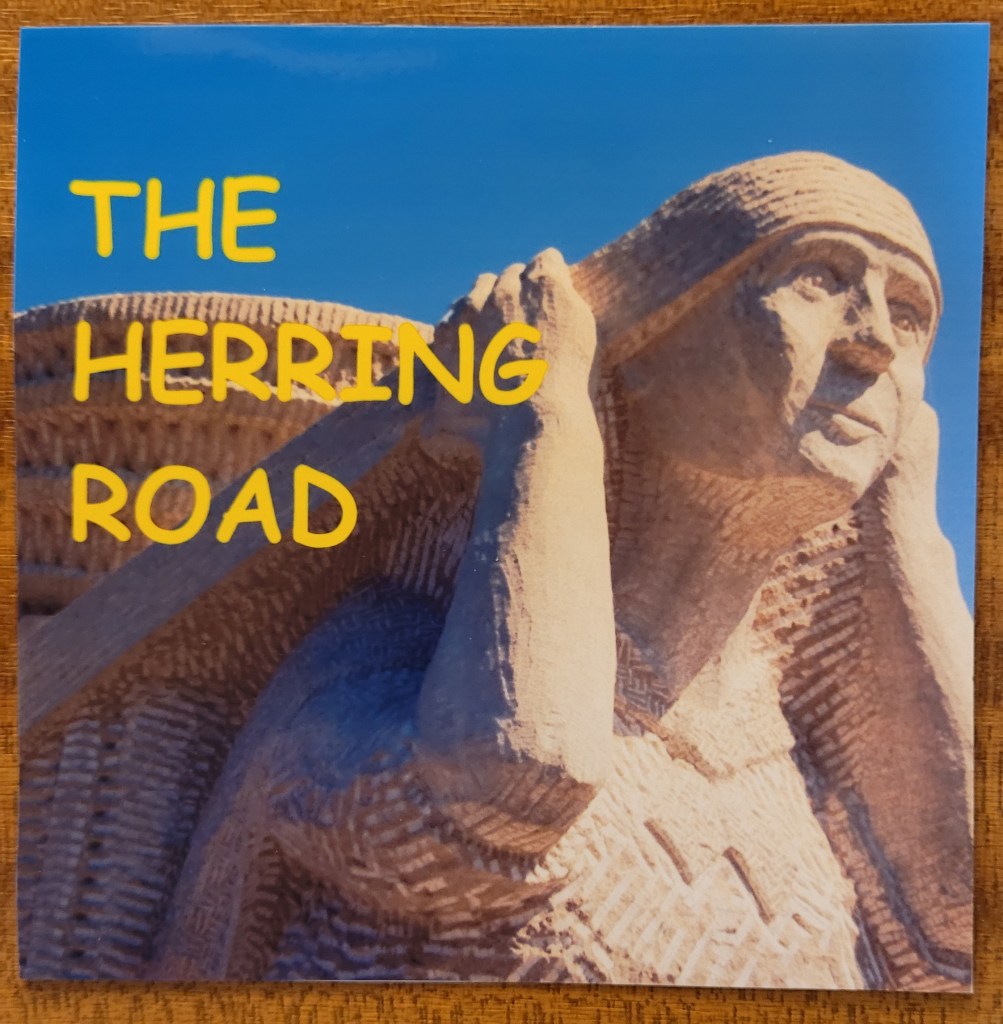
Next, Musselburgh showed the long-awaited presentation from John Knox and Gus Langlands’ Landscape Group entitled “The Herring Road”.

The Herring Road. A Landscape Group Presentation

The presentation began by describing the history of the fishing industry at Dunbar and, through archive photographs, telling the story of the Dunbar fishwives. The presentation was in several parts, each introduced with a reading by Jennifer Davidson. It took us on a 29 mile journey along the Herring Road, which the fishwives used to carry their heavy baskets and creels of fish to sell at the market in Lauder. We were again taken on a virtual journey along this route, visiting landmarks such as the village of Spott, the Witches Stone, the Whiteadder Reservoir, and through the Lammermuir Hills to Lauder. It looked difficult enough to make that journey with photographic equipment, let along while carrying several stone of fish. After the fishwives had sold their fish in Lauder, they had to make the return journey back to Dunbar, being careful to avoid thieves who might want to steal the money they had made. The presentation returned to Dunbar and, by contrast, showed us the modern view of the town and described the modifications which made Dunbar Harbour the way it looks today.

We finished the evening with a series of short presentations from Beeslack, bringing us introductions to the Scottish Wildlife Centre, the City of Edinburgh, Shetland and Australia. All in all it was a fascinating and entertaining evening. Thank you to Beeslack for joining us. You didn’t get any tea and biscuits for a second year running, but I hope we can correct that the next time we host this meeting.

03 February 2022 (Set Subject Competition – Travel in Scotland)

The second of our 3-part set subject competition took place this week.  The competition was judged by George Todd, who won last year’s competition.  13 members had entered 39 images altogether. The theme of “Travel in Scotland” had been interpreted fairly loosely. Some images showed beautiful Scottish landmarks or landscapes which could be reached by travelling in Scotland. A group of trees with a beautiful sky were assumed to be in Scotland. Other images showed Scottish transport, such as a road, ferry, bridge, railway station or viaduct.

George commented on the composition of each image. The landscape images were stronger when they contained three elements: an interesting foreground, a middle ground and a distant background. Some of the images were good in part but were spoiled by containing too much of a particularly uninteresting element, such as a car park or an expanse of water, grass or greenery. George suggested cropping these area to reduce their dominance and rebalance the image. Some of the images showing an empty scene would have been improved by a focal point, such as a person standing in the railway station or a boat on the water.  Images of landmarks were better if they could tell a story by including some characters, and there were some fun images of highlanders, tourists and highland cattle.

The top scorers were (in reverse order):

  • 5th place (47 points)
    • Lorraine Roberts
    • Kevin Johnston
  • 4th place (48 points)
    • George Smith
    • Jennifer Davidson
  • 3rd place (49 points)
    • Malcolm Roberts
    • Gordon Davidson
    • Carol Edmund
  • 2nd place (50 points)
    • Joe Fowler
  • 1st place (51 points)
    • Steven Beard
    • Mike Clark

The top images were:

  • Glenfinnan Viaduct (Steven Beard) – 20 points
  • Racing Along (George Smith) – 19 points
  • Bow Fiddle Rock (Mike Clark) – 18 points
  • Hebrides to Uig Ferry (Jennifer Davidson) – 17 points
  • Scotland for Ever (Joe Fowler) – 17 points
  • Scotland the Brave (Joe Fowler) – 17 points
  • Packhorse Bridge Carrbridge (Malcolm Roberts) – 17 points
  • Mystery Island Cruise (Mike Clark) – 17 points
  • Blue hour at the 3 Bridges (Gordon Davidson) – 17 points
  • Melrose Abbey (Carol Edmund) – 17 points

Steven Beard and Mike Clark have both won the right to judge next year’s competition! Well done to both. The league table after two competitions looks like this:

Joe Fowler (52 + 50 = 102)
Mike Clark (50 + 51 = 101)
Steven Beard (49 + 51 = 100)
Carol Edmund (49 + 49 = 98)
Malcolm Roberts (– + 49 = ??)
Gordon Davidson (45 + 49 = 94)
George Todd (47 + — = ??)
Lorraine Roberts (– + 47 = ??)
Kevin Johnston (– + 47 = ??)
Jennifer Davidson (45 + 48 = 93)

Joe Fowler is in the lead, but only 1 point separates the top 3 places. Entries for the final part of the competition on “Street Photography” are due on 3th March 2022.

27 January 2022 (Human Portrait Print Competition)

27th January was another milestone for Musselburgh Camera Club. We had our first true print competition for 2 years! The last time we reviewed prints at the Fisherrow Centre was for an earlier human portrait print competition on 30th January 2020. This week’s competition was judged by Gordon Scott of Mid Calder camera club. You can see some of Gordon’s work at the link below:

https://www.midcaldercameraclub.org.uk/gallery-gordonscott

This competition was more complex than previous print competitions because we were broadcasting the event to members who preferred to connect by Zoom. We set up a narrow-angle webcam which captured a view of our print stand, and Gordon wore a radio microphone. A wide-angle microphone was used to speak to the members on Zoom. The complexity of the situation lead to some technical issues, and we learned it is important to make a careful note of which microphone is which in the list that Zoom gives you. Gordon was very patient with us.

8 members had entered 24 images altogether. Gordon noted that some of the images (which showed groups of people interacting) stretched the definition of a portrait, which he expected to be of a single person.  There were photographs of people at work, people taking part in a battle re-enactment, people on the street, and images captured from a photoshoot.  John West had entered a selfie, which amused some of the audience.  Gordon commented on the location of the subject within the frame. Some images were cropped a little too tightly, for example cropping off the top of the subject’s hat. Other images seemed to have too much space on one side, or could have been angled differently to show more of an elaborate costume and less background.  Gordon pointed to distractions which could have been removed, darkened or cropped out. He also explained how the depth of field is important. In most portraits it is important to blur out the background to keep attention on the subject; with the exception of subjects who are doing a job, where it is important to be able to see what they are doing.  Some of the images were spoiled by an unfortunate pose, for example a hand which was too dominant. The final thing which separated the best images from the rest was the lighting.  Harsh lighting caused distracting shadows or bright streaks on some portraits. The very best images were captured in soft lighting. Gordon’s top 6 images (which can be seen on our Facebook page) were:

  • Kalia – Green Activist  (George Todd) – 20 points
  • Lean and Mean (Joe Fowler) – 19 points
  • MacAulay Clansman (George Todd) – 19 points
  • Fabrication Welder (Joe Fowler) – 18 points
  • Nguyet (George Todd) – 18 points
  • My Magnificent Beard (Carol Edmund) – 18 points

The top scorers were (in reverse order):

  • 4th place (47 points)
    • Jennifer Davidson
    • Mike Clark
  • 3rd place (49 points)
    • Charlie Briggs
    • Carol Edmund
  • 2nd place (52 points)
    • Joe Fowler
  • 1st place (57 points)
    • George Todd

Congratulations to George Todd, whose 3 images all made the top 6. Thank you to everyone who dusted off their printers and made the effort to enter this competition, and thank you very much to Gordon Scott for judging and putting up with our technical issues.

Next week we have the second of our set subject competitions: “Travel in Scotland”.
See you on Thursday,

Steven

20 January 2022 (Underwater Photography)

This week member Mike Clark gave us a talk on his experiences with underwater photography. Mike had given us a taster of his underwater work more than a year ago at our “International Dutch Members Evening”, which we enjoyed so much we asked him to give this full presentation. We were joined by Mike’s new fans from the Netherlands: Hans van der Boom and Denise Gielen.

Just like our previous underwater speaker, David Keep, Mike had also been inspired by watching “The Undersea World of Jacques Cousteau”. Mike began the evening by showing us his equipment. Mike fits his camera into a waterproof housing which lets him operate his Nikon DSLR camera underwater. The housing has a spherical transparent outer shell which gives even wide-angle lenses a panoramic view. Cleverly placed levers and mechanisms allow Mike to operate the controls of his camera from outside the housing. The housing is fitted with two strobe lights and flotation tanks, which can be manoeuvred on flexible arms. Mike usually operates the strobe lights at less than the maximum brightness because their battery life is limited. Most of the camera’s automatic systems don’t work properly underwater, so Mike needs to adjust the settings manually. Underwater photography requires a lot of concentration, since Mike not only has to watch out for photographic opportunities and adjust his equipment, but he also needs to monitor his air, depth and diving time.

Mike went on to show us a video presentation describing different aspects of his underwater photography. Most of the photographs had been taken around the coastline of Scotland. There were impressive shots of marine wildlife: from seals and monkfish, to squid and colourful sea slugs, ending with sharks and a truly gigantic skate! There were beautiful marine landscapes with delicate anemones and fish. There were also were ship-wrecks with barnacle-encrusted, twisted metal shapes, with a ladder leading invitingly into a dark and dangerous hold from which some divers have never returned. Mike also included some of his signature images: stunning split shots showing a shark or seal underwater together with the diving boat and fellow divers. If you are interested you can see more of Mike’s work on his web site or Flickr photostream (below):

https://9-mike-clark.pixels.com/

DSC_6668-Edit
Mike Clark’s Flikr Photostream

Thank you very much, Mike, for preparing and giving us this presentation. It was very well received, and the Zoom chat was full of admiration for the stunning photographs shown. Best of luck with your future underwater adventures.

06 January 2022 (Set Subject Competition – Reflections)

Our first club meeting after Christmas was the first of our 3 set subject competitions: competition A on the subject of “Reflections”.  The competition was judged by Malcolm Roberts, who had won last year’s competition.

27 images had been entered by 9 members, with different techniques used to capture the reflection. There were images of reflections in lochs, harbours and rivers; and reflections in windows and shiny floors.  Jennifer Davidson had used a puddle to capture a unique reflected view of the Kelpies and Carol Edmond had captured flowers reflected in a mirror and glass table.  But perhaps the most intriguing image was John West’s photograph of a reflection in a spoon.  Malcolm awarded the highest points to the most atmospheric images taken in the best lighting and with the fewest distractions, and Mike Clark’s beautiful “Misty Morning Loch Ard” was admired by all.  Malcolm noted that some of the images had lost detail in the shadows or highlights. He also suggested cropping some images to home in on the detail, or using a different viewpoint to balance the composition (which isn’t always possible when standing on a balcony or next to water).

The top scorers were (in reverse order):

  • 5th place (47 points)
    • George Todd
  • 4th place (48 points)
    • John West
  • 3rd place (49 points)
    • Steven Beard
    • Carol Edmund
  • 2nd place (50 points)
    • Mike Clark
  • 1st place (52 points)
    • Joe Fowler

The top images were:

  • Misty Morning Loch Ard (Mike Clark) – 20 points
  • Island Reflection (Joe Fowler) – 19 points
  • Painterly Reflection (John West) – 18 points
  • Little Mandarin Duck (Joe Fowler) – 17 points
  • Disney Castle (Steven Beard) – 17 points
  • Granton Harbour (Steven Beard) – 17 points
  • Floral Reflection (Carol Edmund) – 17 points

Well done to Joe Fowler, who wins the right to judge next year’s competition.  This is the first of a 3-part competition, with the final result depending on the total score from the best 2 competitions. The observant will notice that only 1 point separates the 2nd, 3rd, 4th and 5th places, so at this stage everybody is still in with a chance.

Please note that the image hand-in date for part 2 of this competition (on the theme of “Travel In Scotland”) is this coming Thursday, 13th January 2022. Please send your 3 JPEG images to George Todd.  Images for the final part of the competition (on the theme of “Street Photography”) are due on 3rd March 2022.

02 December 2021 (Black and White Print Competition)

Our black and white print competition took place on 2nd December 2021.  Like the colour print competition judged earlier in the year, this competition was also judged digitally. The competition was judged by Gordon McMann CAPGB of Queens Park Camera Club, Glasgow.

15 members had entered 45 images altogether. There were landscape shots, some shots of local architecture and artwork, a selection of portraits, some sporting action shots, and a few shots of flowers and wildlife.  Gordon commented on the impact and composition of each image. In some cases there was a loss of detail in the highlights or the shadows, and in other cases the dynamic range had been compressed so the image lacked contrast. Gordon recommended solving both of these problems by dodging and burning. The photographer can “paint” regions of brightness or shadow onto the image to enhance some areas and dampen others. Some of the portraits could have been improved by this method: brightening the face while darkening the light shining through a window; darkening the shadows under the chin to enhance the contrast and give the image more depth. While a lack of contrast can make an image seem flat, so can a blank background.  A portrait or flower image on a plain background can look two-dimensional. Carol Edmond’s image “Dying Roses” was an example of a background that worked. The subtle gradient of tone in the background maintained the depth in the image. Gordon also warned photographers to beware of photographing artwork, like the Kelpies, where the sky shows through the holes. If you darken the sky you need to darken everything shining through the holes as well.  Also, watch out for odd shapes at the edge of the artwork where the shadows don’t look right.  One of the most striking images in the competition was Kevin Johnson’s abstract portrait called “Neg”.  A portrait of a model with a tattoo had been boldly presented as a negative black and white image.

Gordon had classified the images into commended (16 points), highly commended (17 points) and then 1st, 2nd and 3rd. The top images were:

  • Highly commended (17 points)
    • In Control (Jennifer Davidson)
    • The Cove (Jennifer Davidson)
    • What a Scramble (Joe Fowler)
    • Nepali Priest (George Todd)
    • Dramatic Sky over East Neuk (Gordon Davidson)
    • Kelpies (Gordon Davidson)
    • Dying Roses (Carol Edmond)
  • Top 3 images
    • Watching for Danger (Charlie Briggs) – 18 points
    • Emotion 2 (Malcolm Roberts) – 19 points
    • Dreaming of Days Gone By (George Todd) – 20 points

When the points were added up, the top scorers were revealed to be (in reverse order):

  • 5th place (46 points)
    • Charlie Briggs
    • Jennifer Davidson
  • 4th place (48 points)
    • Joe Fowler
    • Mike Clark
  • 3rd place (49 points)
    • Malcolm Roberts
    • Carol Edmond
  • 2nd place (50 points)
    • Gordon Davidson
  • 1st place (52 points)
    • George Todd

Congratulations to George Todd, Gordon Davidson, Malcolm Roberts and Carol Edmund. Next week we have our second members evening, and our last meeting at Fisherrow before Christmas. Jennifer Davidson, George Todd and Gavin Marshall will be presenting their work.

See you on Thursday,

Steven